Key points
- A fixed arm brings repeatable motion to a designed workcell.
- A quadruped takes sensors and payloads through difficult environments.
- A humanoid research platform investigates work in spaces shaped around people.
This source-led explainer compares documented architectures and intended applications. It is not a performance ranking or purchasing recommendation.
The form follows the operating environment
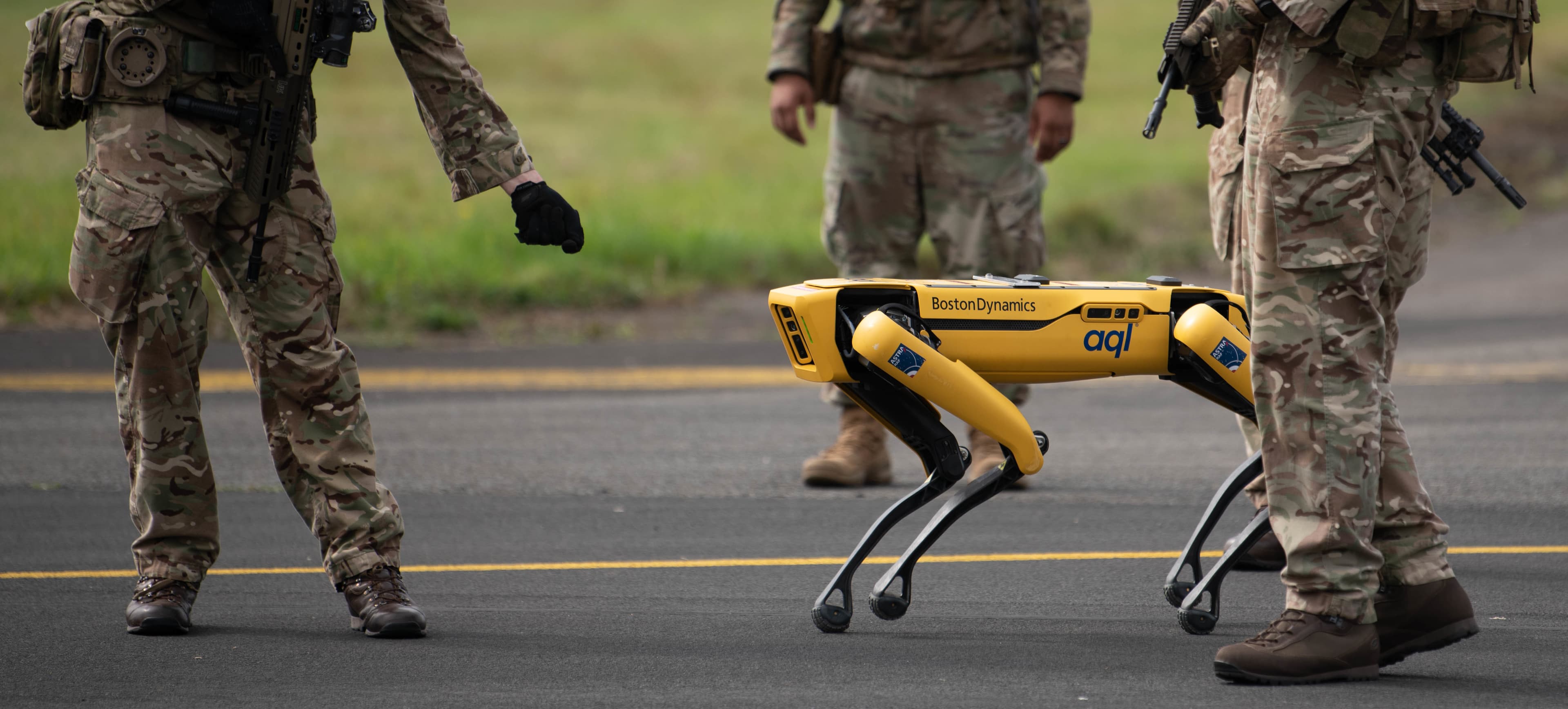
Robot categories solve different access problems. A collaborative arm such as UR5e operates from a fixed base and places six rotating joints inside a defined reach. A quadruped such as Spot carries sensing or other payloads while moving through industrial and hard-to-traverse environments. NASA describes Valkyrie as an entirely electric humanoid for research in degraded or damaged human-engineered environments.
These are not three versions of the same product. Their locomotion, stability, manipulation and integration problems are different, so a useful evaluation must begin with the environment rather than a universal ranking.
Where a fixed arm is the simpler answer
Universal Robots publishes an 850 mm reach, 5 kg maximum payload and six rotating joints for UR5e. Those figures define a compact manipulation envelope around a fixed installation. The completed machine still includes its end effector, fixtures, controls, guarding or other protective measures, and the process being automated.
When work can be brought into a controlled cell, a fixed arm avoids the navigation and energy constraints of a mobile platform. That does not make the application automatic: tool mass, centre of gravity, cycle design and the required risk assessment remain part of the engineering problem.
What mobility changes
Boston Dynamics specifies Spot as a four-legged mobile robot with a maximum 14 kg payload and typical runtime of approximately 90 minutes, subject to payload and environmental conditions. Mobility lets a payload or sensor reach places that cannot be reorganised into a fixed workcell, but it also introduces route planning, communications, charging and terrain constraints.
A maximum payload figure therefore cannot be read in isolation. The useful question is whether the complete configured robot can carry the required equipment, reach the required locations and operate within the published environmental limits for the planned mission.
Why humanoids remain a distinct research question
NASA lists Valkyrie at 6 ft 2 in, 300 lb and 44 degrees of freedom, with an entirely electric architecture and battery capability. The agency presents R5 as a research platform, not as a generally available commercial machine. Its human-like form allows researchers to investigate manipulation and movement in environments originally shaped around people.
That research value should not be confused with commercial readiness. Public specifications do not establish price, general availability, deployment reliability or ownership cost. A responsible comparison leaves those fields unknown and treats the platform according to its documented research role.
Primary sources
- R5 — NASA’s Valkyrie robotNASA · accessed 19 September 2026
- Spot product specificationsBoston Dynamics · accessed 19 September 2026
- Spot specificationsBoston Dynamics Support Center · accessed 19 September 2026
- UR5e technical specificationsUniversal Robots · accessed 19 September 2026