NASA Johnson Space Center · Humanoid · Research platform
Valkyrie R5
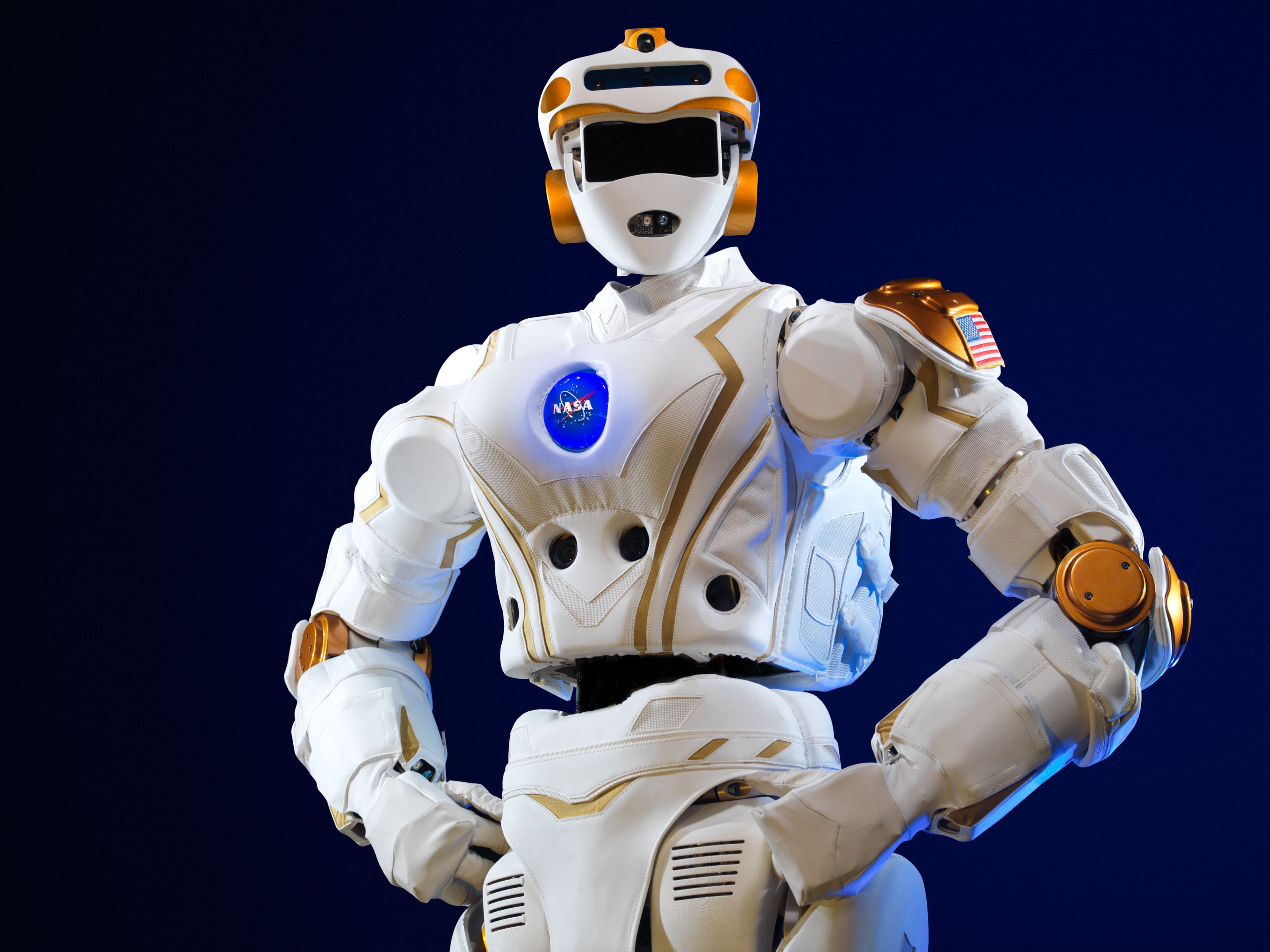
NASA’s R5, also known as Valkyrie, is a 44-degree-of-freedom humanoid research robot designed for work in degraded or damaged human-engineered environments.
Editorial source check: 9 October 2026. Specialist technical review: not yet performed. Why we say this
Key specifications
Every value sourcedFull specifications
19 fieldsPerformance
| Degrees of freedom What is this? | 44 [1] |
|---|
Power
| Battery energy | 1.8 kWh [1] |
|---|---|
| Battery runtime | About 1 hour [1] |
| Power options | Wall power or a custom dual-voltage battery [1] |
Physical
| Height | 6 ft 2 in (1.88 m) [1]NASA publishes 6 ft 2 in; the metric figure is RoboMag's conversion. |
|---|---|
| Weight | 300 lb (136 kg) [1]NASA publishes 300 lb; the metric figure is RoboMag's conversion. |
| Locomotion | Bipedal [1] |
Controller and communications
| Computers | 2 × Intel Core i7 [1] |
|---|
Sensing
| Neck | 3 degrees of freedom [1] |
|---|---|
| Primary perception sensor | Carnegie Robotics MultiSense SL [1] |
| Hazard cameras | Fore and aft in the torso [1] |
| Inertial measurement units | Two, in the pelvis [1] |
Actuation
| Arms | 4 series elastic rotary actuators per upper arm; 7 joints per arm including the forearm [1] |
|---|---|
| Arm serviceability | Quick mechanical and electrical disconnect between the first two arm joints [1] |
| Forearm | One rotary actuator, a pair of linear actuators and 6 finger and thumb actuators [1] |
| Hands | 3 fingers and a thumb [1] |
| Torso | 2 series elastic rotary and 2 series elastic linear actuators [1] |
| Pelvis | 3 series elastic rotary actuators [1] |
| Legs | 5 series elastic rotary actuators per upper leg; each ankle driven by 2 series elastic linear actuators [1] |
Built for damaged human environments
NASA's Johnson Space Center Engineering Directorate designed and built R5, also known as Valkyrie, within 15 months for the 2013 DARPA Robotics Challenge Trials. NASA describes it as able to operate in degraded or damaged human-engineered environments.
After the Trials the team improved the hands, ankles and sensors, and worked with IHMC on walking algorithms for NASA's Space Robotics Challenge. Valkyrie is a research platform, not a product with a published commercial availability date.
A series elastic architecture
NASA's description is built around series elastic actuators: rotary and linear units in the arms, torso, pelvis and legs, with each ankle driven by a pair of linear actuators working together. Each arm has seven joints including the forearm and a quick mechanical and electrical disconnect between its first two joints, which supports transport and servicing.
The head carries a 3-DOF neck and a Carnegie Robotics MultiSense SL as the main perception sensor, with hazard cameras fore and aft in the torso. Two Intel Core i7 computers handle computing, and the robot runs from wall power or a custom dual-voltage 1.8 kWh battery for about an hour.
What remains unknown
NASA’s R5 page does not publish a general purchase price, commercial delivery programme or conventional product-support package. RoboMag therefore records Valkyrie as a research platform and leaves buyer-style fields unknown.
Any claim about current deployment status, autonomy, task success or performance outside the published specification would require newer, directly attributable evidence.
Applications
Editorial summary- Humanoid robotics research
- Degraded-environment research
- Space robotics research
Comparisons
Build your own comparisonNo permanent comparison has been published for Valkyrie R5 yet. RoboMag publishes one only when both machines have enough sourced, like-for-like data. Use the comparison tool to place sourced profiles side by side.
Primary sources
- [1] R5 — NASA’s Valkyrie robotNASA · Page last updated 18 July 2023 · accessed 9 October 2026